

If you’ve been waiting for stress to announce itself with some dramatic breakdown, here’s the thing nobody tells you: the signs of a stressed mom usually show up quietly, in places you’ve stopped paying attention to.
Stress doesn’t always look like crying in the pantry (though sometimes it does). More often it shows up as the jaw you didn’t realize was clenched, the patience that’s grown paper-thin, the to-do list you keep rewriting but never finishing, or the glass of wine that’s become less of a treat and more of a nightly necessity. The tricky part is that these signs tend to creep in so gradually that they become your new normal and you stop recognizing them as stress at all.
So instead of another generic list, let’s do something more useful. Let’s map it.
Stress shows up in four distinct zones: your body, your mind, your mood, and your behavior. Most moms have one or two zones carrying the heaviest load and knowing which is yours tells you a lot about what kind of support you actually need. As you read through each zone below, mentally check off (or grab a pen and actually mark) the signs that feel true for you right now. At the end, we’ll add them up.
Zone One: Your Body — The Signs You’re Carrying It Physically

Your body is often the first to know you’re stressed, long before your conscious mind catches up. That’s because chronic stress keeps cortisol and adrenaline elevated, which produces real, measurable physical symptoms. The problem is we tend to explain these away with thoughts such as, “I’m just getting older,” “I always sleep badly,” “everyone’s tired.”
Check any that feel true:
- You wake up between 2 and 4am regularly, mind already racing
- Your jaw is tight, or you’ve been told you’re clenching or grinding your teeth
- You’re catching every cold that comes through the house
- You have tension headaches or a constantly tight neck and shoulders
- Your digestion has been off, bloating, stomachaches, changes in appetite
- You feel physically exhausted even after a full night’s sleep
- Your heart sometimes races or you feel a flutter of physical anxiety for no clear reason
The body zone is significant because these aren’t “in your head”. They’re your nervous system signaling that it’s been running in overdrive for too long. If most of your checks landed here, your stress has gone physical, and your body is asking for genuine rest and nervous system regulation, not just a better attitude.
Zone Two: Your Mind — The Signs Your Mental Load Is Overflowing

The mind zone is where the invisible work of motherhood shows up as cognitive symptoms. When your brain is tracking 300+ decisions a day, something has to give and usually it’s your ability to focus, remember, and think clearly.
Check any that feel true:
- You walk into rooms and forget why you’re there, multiple times a day
- You lose words mid-sentence or can’t recall things you definitely know
- You can’t concentrate on one thing without your mind jumping to five others
- You replay conversations or worry about things you can’t control
- You feel mentally “foggy,” like you’re operating through a haze
- Making even small decisions (what’s for dinner) feels genuinely overwhelming
- You keep rewriting your to-do list but never feel on top of it
If your checks clustered here, you’re likely carrying a mental load that’s exceeded your cognitive bandwidth. This isn’t a memory problem or a personal failing, it’s cognitive overload, and the fix involves offloading and redistributing, not trying harder to remember everything.
Zone Three: Your Mood — The Signs It’s Showing Up Emotionally

The mood zone is the one most people associate with stress, but it shows up in more ways than just “feeling stressed.” Chronic stress narrows your emotional window, the range of feeling you can handle before tipping into reactivity or shutdown.
Check any that feel true:
- Your patience is paper-thin and small things set you off
- You feel irritable or snappy, then guilty about being irritable
- You’ve started feeling oddly numb or flat, like you’re going through the motions
- You cry more easily than usual, or feel close to tears without clear cause
- You feel a low-grade dread or anxiety humming under everything
- You’ve lost interest in things that used to bring you joy
- You feel resentful of your partner, your kids, your circumstances and don’t like that about yourself
If most of your checks are here, your emotional reserves are depleted. Importantly, numbness counts just as much as irritability. When moms run on empty long enough, feeling nothing is just as common as feeling everything, and it’s an equally important signal.
Zone Four: Your Behavior — The Signs It’s Changing What You Do

The behavior zone is the sneakiest, because these signs often masquerade as personality, habits, or even “self-care.” But changes in what you do, how you cope, connect, and move through your day, are some of the clearest signals of chronic stress.
Check any that feel true:
- You’ve been “rage cleaning” or compulsively organizing to feel in control
- Your evening glass of wine has become a nightly non-negotiable
- You’re scrolling your phone late into the night even though you’re exhausted
- You’ve been withdrawing from friends or canceling plans you’d normally enjoy
- You’re snacking or eating differently. Either grazing constantly or forgetting to eat
- You’ve stopped doing the things that used to keep you grounded (exercise, hobbies, reading)
- You’re procrastinating on things that matter, then panicking about them later
If your checks landed here, stress has started reshaping your daily behavior and coping patterns. These habits often feel like they’re helping in the moment, but many are the nervous system reaching for quick relief rather than genuine regulation.
Your Stress Map: Adding It Up
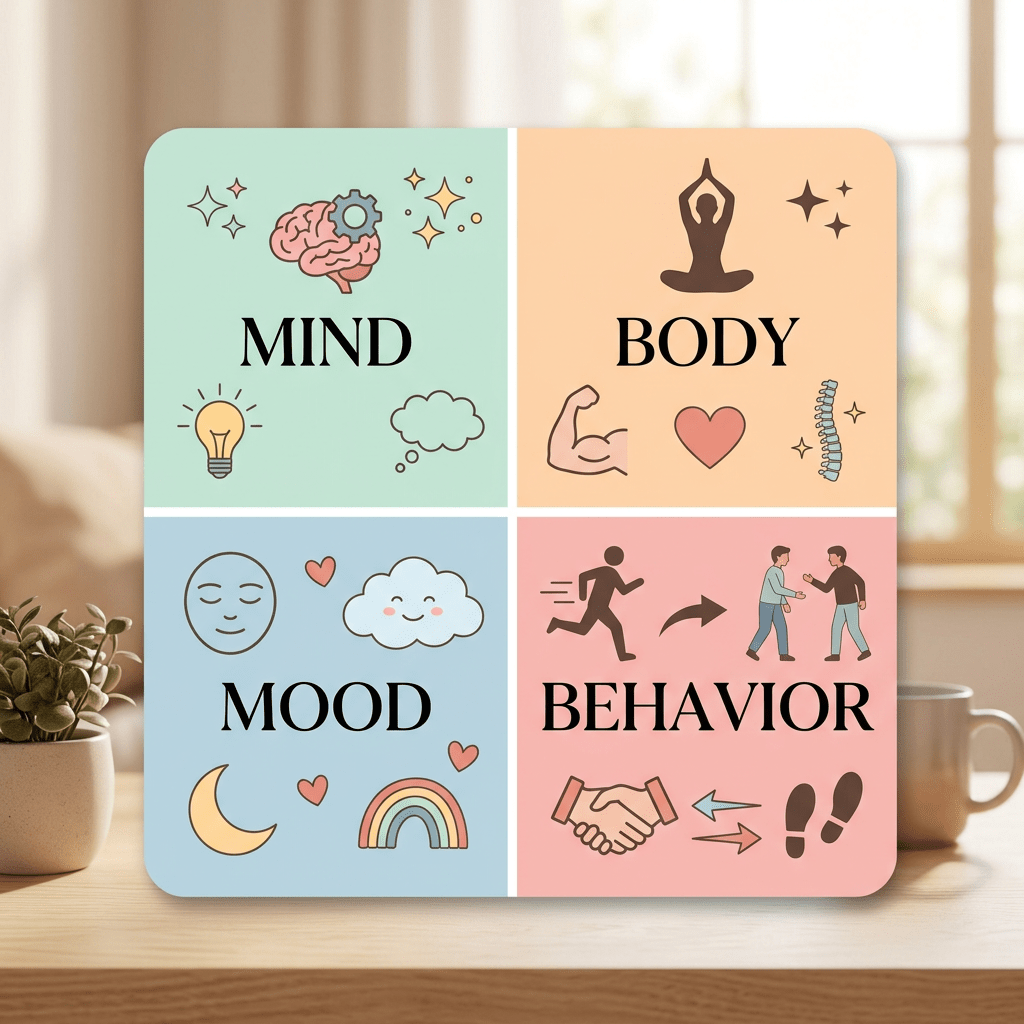
Now count your checks in each zone and notice the pattern. This isn’t about a total score, it’s about where your stress is concentrated.
If one zone is clearly highest: That’s where your stress is currently living, and it tells you where to focus first. A body-zone mom needs physical nervous system regulation and rest. A mind-zone mom needs to offload and redistribute her mental load. A mood-zone mom needs emotional replenishment and likely more support. A behavior-zone mom needs to gently swap quick-fix coping for genuine regulation.
If you checked boxes across all four zones fairly evenly: This is worth paying attention to. Stress that’s saturated all four zones usually means you’ve moved past everyday stress into the territory of genuine depletion or early burnout and that’s a signal to take seriously, not push through.
If you only checked a few, scattered across zones: You’re likely in normal-range stress that’s manageable with consistent small resets. Good, this map is now your early warning system. You’ll notice when one zone starts filling up.
Want to do this properly, pen in hand, away from the screen? I’ve turned this whole assessment into a clean, printable Stress Map you can fill out at the kitchen table, stick on the fridge, and redo each month to track where your stress is shifting. Download the free printable Stress Map here.
What to Do With Your Map
The point of mapping your stress isn’t to alarm you, it’s to replace the vague feeling of “I’m so stressed” with something specific enough to actually act on. “I’m overwhelmed” is hard to fix. “My stress is concentrated in my body and showing up as 2am wake-ups and a clenched jaw” points you straight toward what helps.
Wherever your stress is concentrated, the underlying driver is usually the same: a nervous system that’s been running in overdrive without enough genuine recovery. The signs differ; the root is shared.
If you want to understand the biology underneath all of this, why your body won’t calm down even when you “know” you’re safe, my post on what’s really happening in your stressed body walks through it in plain language.
If your map lit up heavily in the mind zone, your mental load is likely the culprit, and my post on managing the mental load gives you the redistribution strategies that actually lighten it.
And if you need something for right now, a reset you can do in under a minute when one of these signs flare, the 4-3-2-1 grounding technique is the one I reach for most.
A Gentle Place to Start Tomorrow Morning
If this map showed you more than you expected, please don’t add “fix all my stress” to your to-do list, that’s just more load. Start with one small, consistent reset.
If this map showed you more than you expected, start by grabbing the free printable version so you can come back to it whenever you need a check-in. Download your printable Stress Map here.
And when you’re ready for a gentle daily practice, my free 5-Day Morning Reset for Busy Moms gives you one simple, science-backed strategy per day to help your nervous system shift out of overdrive, starting with how you begin your mornings.
When the Map Says It’s More Than Everyday Stress
If you checked boxes across all four zones, or you read the body and mood sections and felt a quiet “oh no, that’s all of me, that’s worth honoring, not pushing past. Stress that’s saturated every zone is often the early architecture of burnout, and the earlier you recognize it, the gentler the road back.
My Burnout Recovery Bundle was built for exactly this moment. It starts with a burnout stage assessment, a more in-depth version of the map you just did, so you can see precisely where you are, then gives you a Nervous System Reset Guide and a Mental Load Assessment and Redistribution Workbook to start the actual recovery.
You can get instant access here for $27.
What I Use and Recommend
For the Body Zone
Magnesium Glycinate — supports the nervous system’s shift into rest and is commonly depleted by chronic stress; I take it before bed.
Rocky Mountain Oils Lavender in a diffuser — research-backed for lowering cortisol through the scent-limbic pathway.
For the Mind Zone
Cozi Family Organizer — gets the mental load out of your head and into a shared system the whole family can see.
For the Mood & Behavior Zones
MamaZen — a mindfulness app built for moms, with short guided sessions for emotional regulation and swapping quick-fix coping for genuine calm.
The Five Minute Journal — a low-effort way to reconnect with yourself when the mood and behavior zones signal depletion.
References
McEwen, B. S. (2017). Neurobiological and systemic effects of chronic stress. Chronic Stress, 1, 1–17. https://doi.org/10.1177/2470547017692328 American Psychological
Association. (2021). Stress in America 2021. APA. Sapolsky, R. M. (2004).
Why zebras don’t get ulcers (3rd ed.). Holt Paperbacks.
Porges, S. W. (2011). The polyvagal theory: Neurophysiological foundations of emotions, attachment, communication, and self-regulation. W. W. Norton & Company.
Daminger, A. (2019). The cognitive dimension of household labor. American Sociological Review, 84(4), 609–633. https://doi.org/10.1177/0003122419859007
About the Author
Jaime is a senior college instructor with an M.S. in Family and Developmental Studies and a certified health, life, and mastery coach. She is married with two teenage sons. Throughout her journey of balancing motherhood, career, and life, she has become an advocate for maternal health and well-being. She believes that when mothers thrive, families flourish.
Affiliate Disclaimer
A quick note: Some links in this post are affiliate links, meaning I may earn a small commission if you purchase through them at no additional cost to you. As an Amazon Associate I earn from qualifying purchases. I only recommend products I personally use and trust.
Health Disclaimer
The content on Balanced Mom Blueprint is for informational and educational purposes only and is not intended to be a substitute for professional medical or psychological advice, diagnosis, or treatment. Always seek the guidance of your physician or other qualified health provider with any questions you may have regarding a medical or mental health condition. If you are experiencing a mental health crisis, please contact a qualified professional or call or text 988 to reach the Suicide and Crisis Lifeline.
 Balanced Mom Blueprint
Leave a comment