

Have you ever found yourself trapped in the whirlwind of motherhood stress, heart racing, thoughts spinning, barely holding it together? Yeah, me too. More times than I care to admit.
As moms, our nervous systems are perpetually on high alert. From the moment we wake up we’re responding to demands, solving problems, and keeping tiny humans alive. Until that blissful (and often brief) moment when our head finally hits the pillow. No wonder our stress response gets stuck in overdrive.
Today I’m sharing a grounding technique for moms that has become my personal emergency button for those moments when life feels completely overwhelming. The 4-3-2-1 Stress Reset Method isn’t just another fluffy self-care tip. It’s a science-backed grounding technique that works with your body’s natural stress response to restore calm quickly, anywhere, in under a minute.
Why Mom Stress Gets Stuck: The Science Behind Your Cortisol Response
Before diving into the technique, let’s understand what’s happening in your body when stress takes over. When your nervous system perceives a threat, it triggers your sympathetic nervous system – the infamous “fight-or-flight” response. This can occur whether from a looming work deadline or your three-year-old perched precariously on the kitchen counter.
Your body releases stress hormones like cortisol and adrenaline, your heart rate increases, your breathing quickens, and your muscles tense. This response was brilliantly designed to help our ancestors escape predators. But it’s not so helpful when triggered by the fifteenth sibling argument of the day.
The problem? Modern mom life keeps many of us stuck in this heightened state. It never fully allows our parasympathetic nervous system (the “rest and digest” mode) to take over. Research shows that chronic activation of the stress response can lead to various health issues. These range from digestive problems to immune system suppression and even cardiovascular issues.
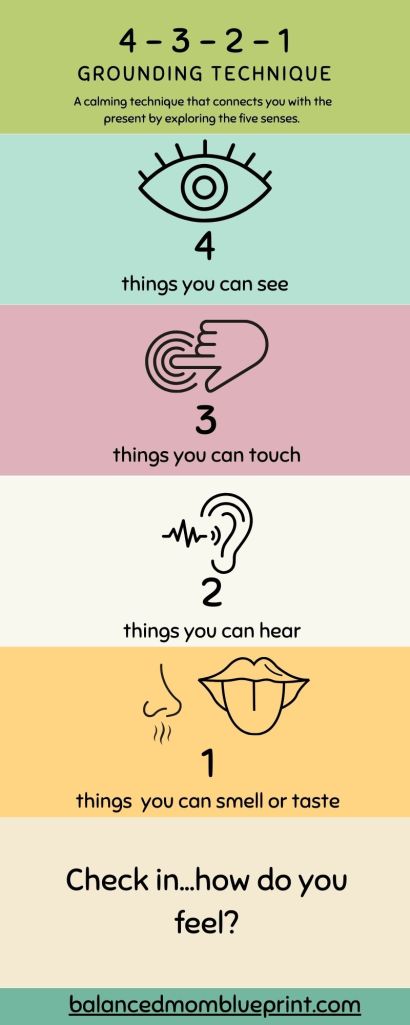
The 4-3-2-1 Grounding Technique: A Step-by-Step Reset for Moms
This technique is effective because it engages multiple sensory systems simultaneously. This effectively “distracts” your brain from the stress response. It also activates your parasympathetic nervous system. It’s based on grounding techniques that have been validated by numerous studies on stress management and anxiety reduction.
Here’s how to do it:
Step 1: Identify 4 Things You Can SEE
Look around you and silently name four things you can see. Be specific – not just “chair” but “my blue office chair with the coffee stain from last Tuesday.” This visual focus helps pull your attention away from internal stress and into the present environment.
Real-world example: When I found myself spiraling after receiving an unexpected bill last month, I named a few things. The stack of books on my bedside table was one. Another was the painting of a vase of flowers hanging in my room. I also named my husband’s sweatshirt and the afternoon sunlight coming through the windows.
Step 2: Acknowledge 3 Things You Can TOUCH
Run your hands over three different textures around you. Notice the sensations – is it smooth, rough, soft, cold, warm? This tactile engagement helps reconnect you with your physical body, which often gets disconnected during stress.
Real-world example: During a particularly challenging work meeting, I touched the smooth surface of my desk. I also touched the soft fabric of my sweater sleeve and the cool metal of my water bottle.
Step 3: Listen for 2 Things You Can HEAR
Close your eyes briefly if it helps, and identify two distinct sounds in your environment. This auditory awareness pulls you out of the mental chatter and into the present moment.
Real-world example: After a disagreement with my husband, I paused to listen. I noticed the hum of the refrigerator and birds chirping outside our kitchen window.
Step 4: Notice 1 Thing You Can SMELL or TASTE
Finally, bring awareness to a scent or taste now present. If nothing is immediately available, keep a small item like a mint or essential oil nearby for these moments.
Real-world example: During a hectic morning rush, I paused. I took a moment to really taste the coffee I’d been gulping down mindlessly. Just that brief moment of sensory awareness helped reset my frantic pace.
The Science Behind Why This Works
This isn’t just feel-good advice – there’s solid neuroscience backing this approach. When you deliberately engage your senses, you activate parts of your brain that can override the amygdala’s alarm system. Additionally, the focused attention required by this exercise activates the prefrontal cortex, which helps regulate emotional responses.

A 2018 study published in the Journal of Behavior Therapy and Experimental Psychiatry found that sensory grounding techniques significantly reduced anxiety levels. These techniques also helped participants shift from emotional reactivity to responsive awareness.
Dr. Stephen Porges, developer of the Polyvagal Theory, explains that multi-sensory grounding exercises like the 4-3-2-1 method help stimulate the vagus nerve. The vagus nerve is instrumental in activating your body’s relaxation response. This vagal activation is what helps shift you from “fight-or-flight” to “rest and digest” mode.
If you want to go deeper on how chronic stress affects your nervous system, my post on resetting your nervous system after chronic stress walks through exactly what’s happening in your body and four tools to help.
How to Use This Grounding Technique in Real Mom Life
I know what you’re thinking: “That sounds great, Jaime, but when am I supposed to do this? Between making school lunches and keeping up with laundry mountain, I barely have time to pee alone!”
This technique is beautiful because it requires no special equipment. It can be done anywhere. It takes less than a minute. Here’s how to incorporate it:
- Use transition moments – Practice the 4-3-2-1 method during natural transitions in your day. Do this before getting out of your car. You can also do it while waiting for water to boil. Try it before entering your home after work.
- Make it a family practice – Teach your kids this technique! Not only will it help them develop healthy stress management skills, but it can become a family reset button when tensions run high. My youngest now asks for a “senses check” when he feels overwhelmed, and it’s become our special way to reconnect.
- Set environmental triggers – Place small visual reminders in stress hotspots around your home. I have a small “4-3-2-1” note on my bathroom mirror and another on my computer monitor.
- Pair it with breathing – For an enhanced effect, begin the exercise with three deep belly breaths. This primes your parasympathetic nervous system and magnifies the calming benefits.
From Surviving to Thriving: Beyond the Emergency Reset
While the 4-3-2-1 method works brilliantly as an in-the-moment intervention, the ultimate goal is to create a life where our nervous systems aren’t constantly triggered. This requires a more comprehensive approach to stress management and self-care topics I’m passionate about helping moms navigate.
One tool I recommend for building that daily practice is MamaZen. Unlike generic meditation apps, MamaZen was created specifically for mothers. This means the sessions actually speak to what we’re going through. The guided exercises are short (most under 5 minutes), and they address real mom struggles like overwhelm, racing thoughts at bedtime, and guilt. I think of it as having the 4-3-2-1 method as your emergency button and MamaZen as your daily training ground. Together they’re a powerful combination for lasting calm. [Try MamaZen here ]
If you want to understand the science behind what you just practiced , which is the neuroscience of grounding, vagal tone, and stress regulation, Mindful.org’s Get Started with Mindfulness course is the resource I recommend most. It’s grounded in research and written in plain language that actually makes sense for a busy mom reading between school drop-off and dinner. [Explore Get Started with Mindfulness here]
Explore some of my earlier posts for additional ideas on stress management:
- 6 Practical Self-Care Ideas for Busy Moms: Quick Ways to Find Time for You
- The Science of Mom Burnout: Understanding and Prevention
- Creating Boundaries: How to Say No Without Mom Guilt
- Time Management Secrets for Working Moms
- Managing Mom Anxiety: Practical Coping Strategies
Remember: you deserve more than just emergency stress fixes. You deserve a life where calm is your baseline, not just a brief respite between chaos.
Ready to Transform Your Relationship with Stress?
If you found the 4-3-2-1 method helpful, you’ll love my free guide: “The Balanced Mom Blueprint: 5 Science-Backed Strategies to Reclaim Your Calm.” This comprehensive resource dives deeper into evidence-based techniques for managing stress. It also creats sustainable self-care practices that work for real mom life.
[CLICK HERE to get your free guide instantly delivered to your inbox!]

As a bonus, you’ll also receive my weekly Evidence-Based Wellness emails with practical tips and strategies to help you thrive, not just survive, in motherhood.
What I Use and Recommend
Practicing Mindfulness: 75 Essential Meditations for Finding Peace Everyday by Matthew Sockolov
Rocky Mountain Essential Oils: Both Lavender and Cedarwood are my favorites to aid in relaxation.
[MamaZen — Mindfulness App for Moms]. The only mindfulness app built specifically for mothers. Short, practical sessions designed for real mom life.
Mindful.org Audio Meditations — Research-grounded guided meditations that pair beautifully with the 4-3-2-1 technique as a daily practice for nervous system regulation.
References
- Porges, S. W. (2011). The Polyvagal Theory: Neurophysiological Foundations of Emotions, Attachment, Communication, and Self-regulation. Norton & Company.
- Khalsa, S. S., et al. (2018). Interoception and Mental Health: A Roadmap. Biological Psychiatry: Cognitive Neuroscience and Neuroimaging, 3(6), 501-513.
- Van der Kolk, B. (2014). The Body Keeps the Score: Brain, Mind, and Body in the Healing of Trauma. Viking.
- Goldstein, D. S. (2010). Adrenal responses to stress. Cellular and molecular neurobiology, 30(8), 1433-1440.
What stress reset techniques have worked for you? Share in the comments below! I respond to every comment personally and would love to hear your experiences!
About the Author: Jaime is a senior college instructor with a M.S. in Family and Developmental Studies. She is a certified health, life and mastery coach. She is married with two teenage sons. Throughout her journey of balancing motherhood, career and life she has become an advocate for maternal health and well-being. She believes that when Moms thrive, families flourish.
A quick note: Some links in this post are affiliate links, which means I may earn a small commission if you purchase through them, at no additional cost to you. As an Amazon Associate, I earn from qualifying purchases. Rest assured, I only recommend products I actually use and trust for myself and my family.
 Balanced Mom Blueprint
Leave a reply to Building Resilience: How to Bounce Back from Difficult Days – Balanced Mom Blueprint Cancel reply